
Table of Contents
ToggleIn recent years, people have become more conscious of their health and well-being. They no longer resort to regular health check-ups and diagnostic tests only when illness appears; these tests have become a core part of their preventive care. As a result, testing volume has increased significantly, along with expectations for faster, more accurate results.
In response to these growing demands, pathology laboratories have had to evolve. The labs that once relied almost entirely on manual, microscope-based examination gradually adopted automated systems to improve efficiency and consistency. Today, this evolution is continuing with the integration of Artificial Intelligence. Laboratories are leveraging AI and its advanced analytical capabilities to deliver results that are not only quicker but also more precise and dependable. This shift towards AI represents a transformative leap forward in the future of healthcare and highlights the growing importance of advanced healthcare education and training. Through this blog, we explore how AI and Automation are revolutionising diagnostics.
Automation and the Role of AI in Pathology
Automation in pathology refers to the use of advanced machines to perform tests that were traditionally done manually, such as analysing blood, tissue, and fluid samples. It helps in reducing turnaround time and improving consistency across large test volumes.
AI takes this further by expanding these capabilities through machine learning and deep learning algorithms. AI tools evaluate images, recognise abnormal patterns, and flag findings that may require closer review. Moreover, AI-powered solutions also analyse patient data, test histories, and current symptoms to provide vital diagnostic information to detect disease early and guide treatment decisions. These tools are not only streamlining lab workflows but also improving clinical efficiencies.
Applications of AI in Pathology Laboratories
1. Digital Slide Analysis
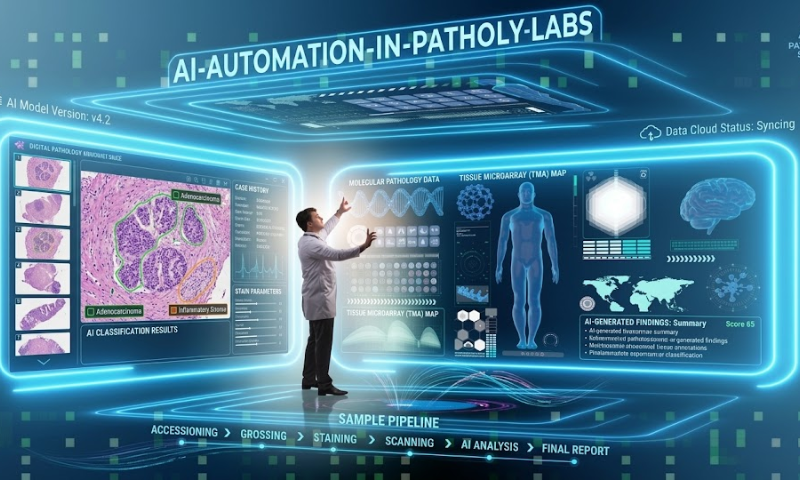
AI can analyse high-resolution images of cells, such as red blood cells, white blood cells, platelets, and even cancer cells. It can identify abnormalities, grade tumors, and detect rare or atypical cells with exceptional speed and precision- often surpassing human capability.
2. Workflow and Specimen Management
AI-based solutions ensure each sample is properly tracked throughout the testing process. It minimises the risk of mislabelling or loss. It also helps manage and streamline lab workflows, automatically prioritising urgent cases to avoid delays.
3. Quality Control
AI-powered systems can detect issues such as tissue folds, air bubbles, and incomplete staining. It ensures higher accuracy and consistency in lab test results.
4. Integration with Laboratory Robotics
In advanced laboratories, robotic systems handle sample preparation, labelling, and scanning. The integration of AI with these robotic systems minimises manual handling, reduces error rates, and improves the overall efficiency of laboratories.
5. Predictive and Analytical Insights
AI can analyse large datasets to forecast disease progression and even anticipate how patients may respond to certain therapies. These insights support personalised medicine approaches and may help clinicians make more informed therapeutic decisions.
Benefits of AI Adoption in Pathology
- Faster Turnaround Times: Critical results reach doctors in hours instead of days.
- Improved Accuracy: Automated detection minimises human oversight and error.
- Consistency: Traditionally, lab results were affected by fatigue and subjective interpretation of lab professionals. However, AI and automation ensure uniform results without subjection.
- Scalability: Labs can handle larger volumes of tests without increasing the staff proportionally.
- Better Patient Outcomes: Early and precise diagnoses allow for timely and targeted treatment.
Challenges and Considerations
Despite its advantages, AI implementation in pathology presents certain challenges. These are as follows:
- Data Privacy & Compliance: Patient data must be securely managed and meet strict regulatory standards.
- Algorithm Validation: AI models require continuous training across diverse populations to ensure reliability.
- Human-AI Collaboration: AI does not intend to replace pathologists, but rather it supports them in handling routine tasks so that experts can focus on complex cases and personalised care.
The Future of Pathology Laboratories
AI-driven pathology is paving the way for fully digitised labs, where automation handles routine workflows, allowing pathologists to focus on advanced diagnostics and patient care. With continuous advancements, AI will make labs smarter, faster, and more accessible- ultimately transforming the delivery of healthcare.
निष्कर्ष
Artificial Intelligence is revolutionising diagnostics by enhancing the speed, accuracy, and efficiency of pathology labs. AI is complementing lab professionals’ tasks by analysing slides, managing specimens, and predicting disease outcomes.
By embracing this technology, pathology labs can deliver quicker, more reliable diagnoses, reduce costs, and, most importantly, save more lives. AI is more than an innovation; it is the future of modern diagnostic medicine.