
Table of Contents
ToggleIn international logistics, documentation plays a vital role in ensuring the seamless movement of goods across borders. Two of the most significant documents in this field are the Forwarder’s Certificate of Receipt (FCR) and the Bill of Lading (B/L).
While both serve as proof of goods receipt, they differ in function, legal implications, and their role in global trade. This comparative study highlights the key differences between these documents and their importance in international logistics.
Understanding the distinction between Bill of Lading vs FCR is essential for exporters, importers, freight forwarders, logistics professionals, and students pursuing careers in international logistics.
What is a Bill of Lading?
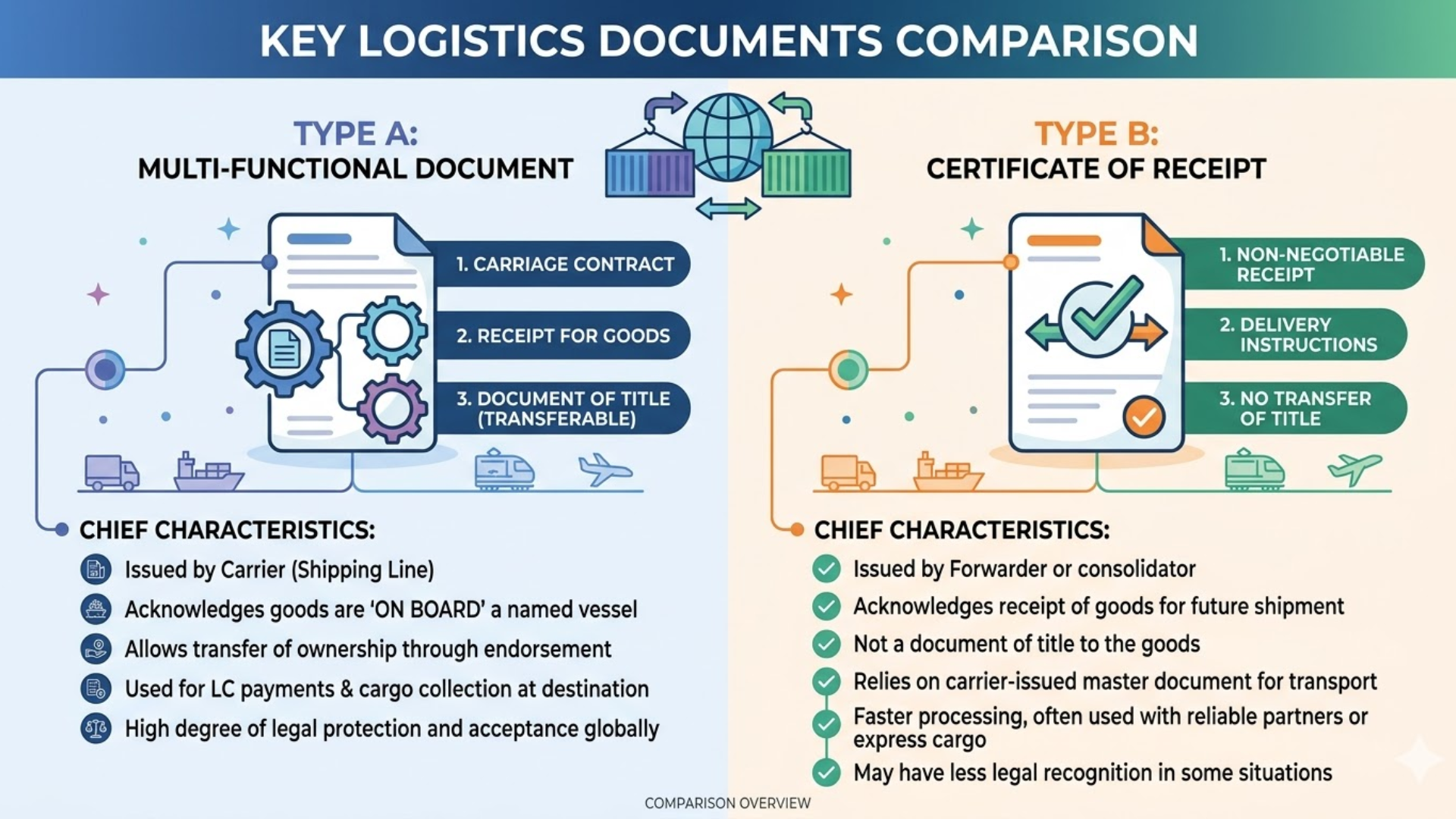
A Bill of Lading (B/L) is a legal transport document issued by a carrier or its authorized agent that confirms goods have been received for shipment. It also outlines the terms of transportation and acts as a document of title that allows the holder to claim ownership of the cargo.
In international trade, the Bill of Lading performs three essential functions:
- Receipt of goods shipped
- Contract of carriage between shipper and carrier
- Document of title representing ownership of the cargo
Because of these functions, the Bill of Lading is one of the most critical documents in global shipping and trade finance.
What is an FCR (Forwarder’s Certificate of Receipt)?
A Forwarder’s Certificate of Receipt (FCR) is a document issued by a freight forwarder confirming that goods have been received from the exporter for shipment under agreed conditions.
Unlike a Bill of Lading, the FCR does not represent ownership of the cargo and does not serve as a contract of carriage. Instead, it primarily acts as proof that the freight forwarder has taken custody of the goods and that the shipping process has begun.
FCRs are commonly used in open account transactions, where exporters require evidence that goods have been dispatched.
Importance of Shipping Documents in International Trade
Shipping documents serve multiple purposes in global logistics, including:
- Proof of cargo receipt
- Contract of carriage
- Ownership or title evidence
- Trade finance collateral
- Customs clearance support
Errors or misuse of shipping documents can lead to:
- Payment delays
- Cargo holds at ports
- Legal disputes
- Financial risks for exporters and importers
This makes it essential to understand when an FCR should be used and when a Bill of Lading is mandatory.
Understanding the Forwarder’s Certificate of Receipt (FCR)
An FCR is a non-negotiable document issued by a freight forwarder to confirm receipt of goods from the consignor for transportation under agreed terms. It assures exporters and financial institutions that the shipping process has commenced.
Key Characteristics of an FCR
- Proof of Goods Receipt: Confirms that the freight forwarder has taken possession of the cargo.
- Non-Negotiable: Unlike a Bill of Lading, an FCR does not transfer ownership of goods.
- Trade Finance Support: Facilitates payments under open account transactions.
- Limited Legal Authority: It acknowledges receipt but does not serve as a contract of carriage.
- Issued by Freight Forwarders: Typically provided by FIATA-affiliated or independent freight forwarding companies.
Understanding the Bill of Lading (B/L)
A Bill of Lading is a legal document issued by a carrier or its authorized agent that acts as a contract of carriage, receipt for goods, and document of title.
Key Characteristics of a Bill of Lading
- Contract of Carriage: Serves as a formal agreement between the shipper and carrier.
- Transferable and Negotiable: Depending on the type, it can be used to transfer ownership of goods.
- Essential for Trade Finance: Used in documentary credit transactions under Letters of Credit (LC).
- Required for Cargo Release: The consignee must present an original B/L to claim goods at the destination port.
- Issued by Shipping Carriers: Provided by ocean carriers, airlines, or multimodal transport operators.
Types of Bill of Lading
There are several types of Bills of Lading used in international trade depending on the nature of shipment and financial arrangements.
- Straight Bill of Lading: Non-negotiable document used when goods are delivered directly to a named consignee.
- Order Bill of Lading: Negotiable document that allows transfer of ownership through endorsement.
- Bearer Bill of Lading: Ownership of goods is transferred simply by possessing the document.
- House Bill of Lading (HBL): Issued by freight forwarders to the shipper.
- Master Bill of Lading (MBL): Issued by the main carrier or shipping line.
Understanding these types helps exporters and importers manage logistics and financial transactions efficiently.
Information Included in a Bill of Lading
A Bill of Lading typically includes the following shipment details:
- Name and address of the shipper
- Name of the consignee
- Description and quantity of goods
- Port of origin and port of destination
- Freight charges and shipping terms
- Date of shipment and vessel details
These details ensure transparency and legal accountability in international trade transactions.
Comparative Analysis: FCR vs Bill of Lading
| Feature | FCR | Bill of Lading (B/L) |
| Issuer | Freight forwarder | Shipping line or carrier |
| Legal Status | Proof of receipt | Contract of carriage |
| Negotiability | Non-negotiable | Can be negotiable or non-negotiable |
| Title Transfer | Does not transfer ownership | Can act as a document of title |
| Purpose | Confirms cargo handover | Provides shipment terms and conditions |
| Trade Finance Role | Supports payment processing | Used in Letters of Credit transactions |
| Cargo Release | Not required | Required to claim goods |
Implications in International Logistics
1. Role in Trade Finance
FCR
- Used primarily in open account transactions
- Provides proof of cargo dispatch to buyers
Bill of Lading
- Essential in Letter of Credit transactions
- Serves as collateral for banks
- Controls cargo ownership until payment
2. Legal and Commercial Significance
FCR
- Acknowledges receipt of goods
- Does not create a legal contract of carriage
Bill of Lading
- Serves as a legally binding contract
- Enforceable under maritime law
3. Risk and Security Considerations
FCR
- Limited legal protection
- No ownership rights
Bill of Lading
- Provides security for exporters and banks
- Prevents cargo release without original document
4. Operational Usage
FCR
- Suitable for freight forwarder consolidations
- Useful in multimodal shipments
Bill of Lading
- Required for direct shipments via ocean or air carriers
When to Use FCR or Bill of Lading
Use FCR if:
- The transaction does not require a document of title
- Immediate proof of dispatch is required
- A freight forwarder manages the shipment
Use Bill of Lading if:
- Trade finance or Letters of Credit are involved
- Ownership transfer of goods is required
- The consignee must present a document to claim goods
Conclusion
Both the Forwarder’s Certificate of Receipt (FCR) and the Bill of Lading (B/L) are indispensable in international logistics, but their roles differ significantly.
The FCR serves as proof of receipt without legal obligations, while the Bill of Lading functions as a legally binding shipping document with contractual, financial, and ownership functions.
Understanding the differences between Bill of Lading vs FCR enables exporters, importers, and logistics professionals to manage risks, comply with trade regulations, and ensure smooth international shipping operations.
For professionals and students entering the logistics industry, mastering shipping documentation is essential for successful participation in global trade.