
Patient safety is a top priority for modern healthcare providers, as ensuring a safe environment for patients and staff alike is essential for the delivery of quality care. The concept of patient safety first emerged in the late 1990s. It sought to address the growing concern about the mistakes and errors that can occur in healthcare processes, particularly in a clinical setting. At its core, patient safety is an area of healthcare that revolves around averting mistakes and accidental injuries to patients.
Let us dive deep into the Six International Patient Safety Goals (IPSG goals) laid down by the International Commission for Patient Safety. These International Patient Safety Goals address specific areas of concern in some of the most challenging aspects of patient safety.
Why do Allied Health Professionals learn this at the Healthcare Academy level?
Patient safety is not a checklist to be memorised; it is a mindset to be lived every single day. When safety practices are introduced only after entering the workforce, errors become lessons learned the hard way – often at the cost of patient well-being. Embedding the International Patient Safety Goals at the training stage ensures that safety becomes instinctive, not instructional. This early conditioning transforms students into confident healthcare professionals who act correctly even under pressure-because for them, patient safety is not an obligation, it is second nature.
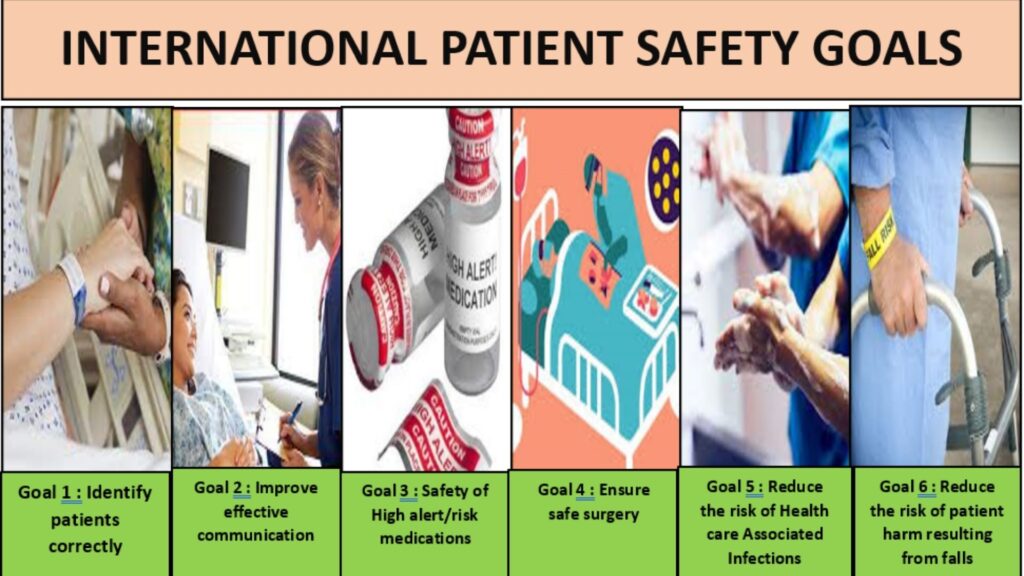
Goal 1: Identify Patients Correctly
Before conducting any procedure, it is mandatory to check and confirm the patient’s full name and hospital registration number on the identification band and patient file to avoid any confusion and establish therapeutic communication. This is one of the most fundamental International Patient Safety Goals and forms the foundation of safe clinical practice.
Goal 2: Improve Effective Communication
The use of standard healthcare communication tools during clinical handover at the bedside or while reporting clinical information to doctors can avoid unnecessary errors. Communication tools such as ISBART are recommended under the IPSG goals.
I: Introduction – Self-introduction and patient identification
For example:
“Good Morning Sir, myself Mr. Anand Sharma, your Nursing Assistant for today. May I check your I.D. please?”
S: Situation – Understanding the patient’s current condition
“Can you tell me what exactly is happening to you?”
B: Background – Reviewing patient history, complaints, diagnosis, prognosis, etc.
A: Acknowledge/Assessment – If the patient is experiencing pain, assessments should be conducted using a standard pain rating scale and reported to the concerned physician.
R: Recommendations – Communicate clearly and carry out physician orders immediately while overcoming communication barriers.
T: Thank You – After appropriate intervention and resolution of the issue, healthcare workers should courteously thank the patient before leaving the bedside.
Goal 3: Safety of High-Alert / Risk Medications
Colour coding of high-alert medications along with look-alike and sound-alike drugs, use of read-back and repeat-back policies during administration, proper storage, labelling, and expiry-date checks in locked compartments can prevent medication errors. This goal is a critical part of the International Patient Safety Goals (IPSG goals) framework.
Goal 4: Ensure Safe Surgery
Implementation of a surgical safety checklist can prevent harm to patients. It reduces surgical morbidity, mortality, and sentinel events by confirming the patient’s identity, site of surgery, procedure, informed consent, allergies, airway risks, risk of blood loss, sponge counts, and instrument counts.
Basic five steps as advocated by the National Patient Safety Agency for safe surgery:
- Briefing: Planning discussions among team members, clarifying roles and responsibilities
- Sign-in: Before induction of anaesthesia, confirming patient identity, consent, procedure site, allergies, and risks
- Time-out: After induction and before incision, team introductions and review of anticipated critical events
- Sign-out: After wound closure, confirming procedure performed, swab counts, and recovery plan
- Debriefing: Discussing teamwork, errors, learning points, and shared perspectives
This structured approach aligns directly with the International Patient Safety Goals for surgical care.
Goal 5: Reduce the Risk of Healthcare-Associated Infections
Infections such as Ventilator-Associated Pneumonia (VAP), Central Line-Associated Bloodstream Infections (CLABSI), Catheter-Associated Urinary Tract Infections (CAUTI), and bedsores can be prevented through effective implementation of hospital infection control policies such as hand hygiene and continuous monitoring using CDC bundle guidelines. Infection prevention remains a core component of the IPSG goals.
Goal 6: Reduce the Risk of Patient Harm Resulting from Falls
Risk assessment for falls, use of patient safety devices such as anti-skid floor mats, proper footwear, safety belts during transportation, side rails for beds or stretchers, and patient shifters can significantly reduce patient harm. This goal reinforces patient-centred care within the International Patient Safety Goals framework.
Why should Allied Health Professionals learn IPSG at the academy level?
With a patient safety–centric view, healthcare providers are obliged to follow these International Patient Safety Goals effectively. However, practising them without error requires strong foundational knowledge, which can only be achieved through structured education and training during the academic phase.
This early exposure helps students understand the core values, requirements, and criteria needed to deliver safe patient care with confidence.
The following points highlight the importance of teaching IPSG goals during training:
- Understanding the global context: The International Patient Safety Goals provide a universal framework, aligning patient safety efforts across healthcare systems worldwide.
- Improving patient outcomes: Adherence to the six goals reduces preventable harm and improves quality of care.
- Ensuring safety in all settings: The goals apply across hospitals and community care settings alike.
- Fostering a culture of safety: They encourage open communication, teamwork, and continuous learning.
- Empowering patients and families: Patients and families become active participants in ensuring safety.
- Driving change and improvement: The goals act as a roadmap for continuous patient safety enhancement.
Efforts are needed to establish a strong culture of patient safety by creating an open, non-punitive environment supported by systematic education and training across all healthcare organizations.
As the saying goes,
“Modern medicine heavily invests in information technology, yet the promised improvements in patient safety and productivity frankly have not been realized.”
It is essential to embrace patient safety principles as a core part of standard healthcare training. Patient safety is a collective responsibility, and it begins with each one of us.
At the Tech-Mahindra Foundation SMART Academy for Healthcare, we have made a deliberate commitment not only to introduce the significance of patient safety but also to integrate the International Patient Safety Goals (IPSG goals) as a fundamental component of technical training. This ensures our students are fully prepared to meet real-world healthcare challenges with competence and confidence.
FAQs
The International Patient Safety Goals are a set of six globally recognised objectives designed to reduce preventable harm to patients during healthcare delivery. These goals focus on patient identification, communication, medication safety, safe surgery, infection control, and fall prevention.
IPSG stands for International Patient Safety Goals. The term IPSG goals is commonly used in hospitals and healthcare training programs to refer to standardized patient safety practices.
The IPSG goals help hospitals minimise medical errors, improve patient outcomes, ensure consistency in care, and foster a strong culture of safety among healthcare professionals.
All healthcare professionals—including nurses, allied health professionals, technicians, and support staff—should be trained in the International Patient Safety Goals, ideally starting at the healthcare academy or training level.
By following the IPSG goals, healthcare workers can prevent misidentification, communication gaps, medication errors, infections, surgical complications, and patient falls—leading to safer and higher-quality patient care.
No. The International Patient Safety Goals apply across all healthcare settings, including hospitals, clinics, community health centres, and home care environments.
Early training in IPSG goals builds confidence, improves clinical decision-making, and prepares students to handle real-world healthcare scenarios safely and professionally.
At Tech-Mahindra Foundation SMART Academy for Healthcare, the International Patient Safety Goals are embedded directly into technical training modules, ensuring students practise patient safety as a core competency-not just a theoretical concept.