Table of Contents
ToggleBeing a job seeker or a professional looking to advance, one of the major questions that may come to your mind is: how can I be sure that my profile is competitive and thriving since the very beginning of the recruitment process?
You may have heard about the dreaded “strengths and weaknesses” question, and of course, you may have doubts. Is it safe to be honest? Is it necessary to reveal a real flaw? Is it possible that my answer can benefit my chances of being hired? These are not baseless fears, and it is your responsibility as a candidate to pose these questions.
You are in the right place if you are seeking an overall understanding of professional interview techniques. We will provide all your answers, discuss the philosophy of self-assessment, and assist you in making the decision whether a specific response is the right choice to make in relation to your career in this ultimate guide.
Why Consider Your Strengths and Weaknesses?
Most candidates believe that after a standard education, their profile must be in perfect alignment with what employers want. What most people, however, fail to understand is that interviews can put pressure on candidates as they present their skills and personality to hiring managers.
In routine interviews, the character and skills of a candidate are put under pressure as they are scrutinized by hiring managers. This stress can be even greater in situations involving high-stakes roles, career pivots, or the use of generic answers that lack depth.
This does not, however, imply that something is wrong with having areas for improvement. However, even the slightest misalignments in how you communicate your value may influence the functioning of your career growth. Given that the interview regulates your path to employment, minor imbalances may occasionally show up as difficulty securing a role.
A professional development guide comes to the rescue here. The philosophy of interviewing is quite simple: Interview success often depends on how well candidates understand and communicate their strengths and areas for improvement. When candidates develop this self-awareness, their professional growth becomes easier and more sustainable.
15+ Strengths to Share in an Interview
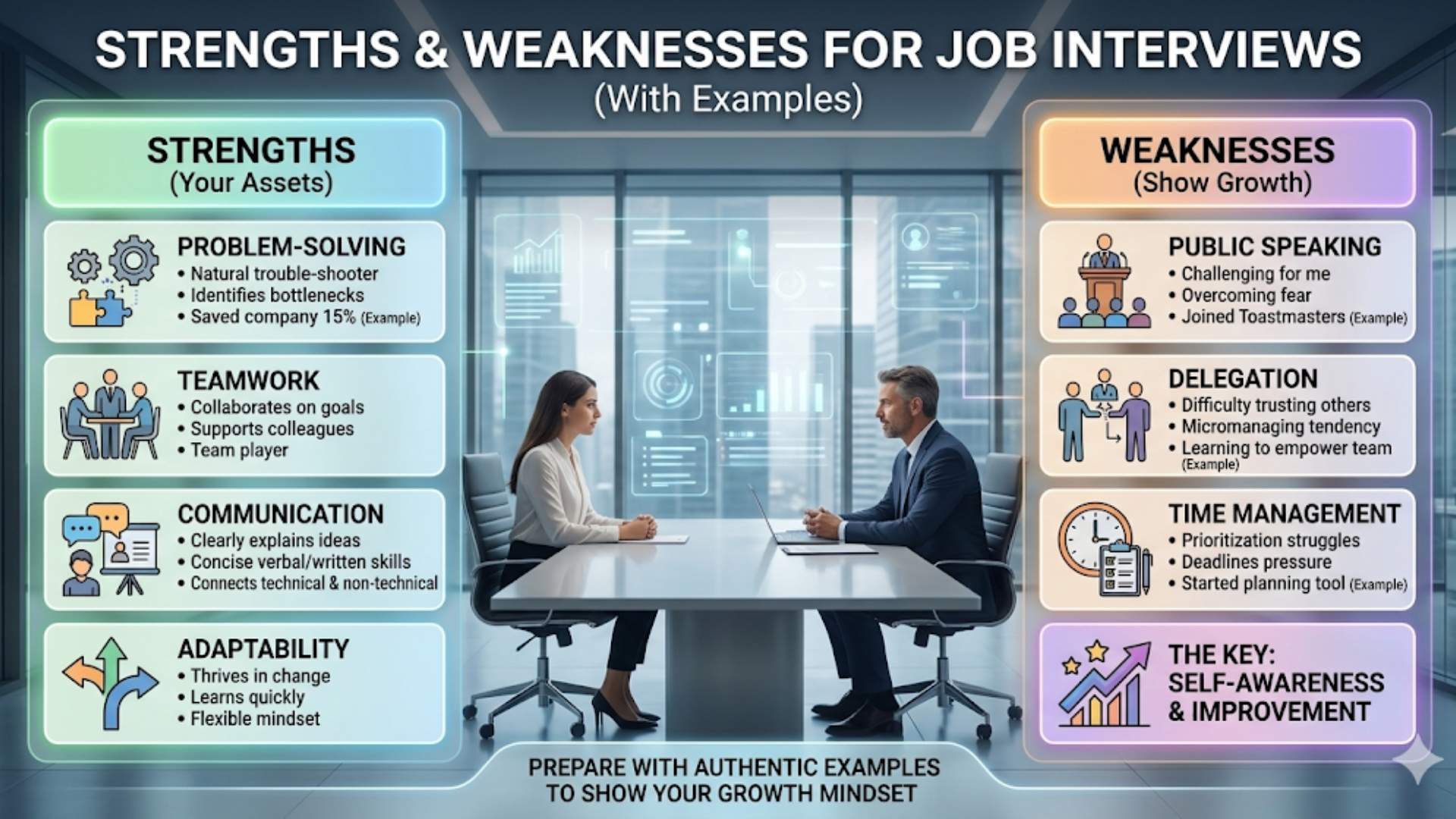
When the recruiter asks about your strengths, candidates normally share general traits. We will consider some of the common strengths and how they can be of help to your application.
1. Adaptability
The contemporary workplace is in a constant state of change. In case a candidate lacks understanding of adapting to new technologies or workflows, the development of the company can be slowed down. Flexibility is one of the strengths that keeps you in the appropriate state to deal with change.
Example: “I am well-versed in adjusting to new software systems, such as when my previous office transitioned to a new project management tool since the very beginning of the quarter.”
2. Problem-Solving
Latching onto a solution may be a gruesome task if you lack analytical skills. A professional who can identify a problem and coordinate a fix is highly valued.
Example: “I focus on the restoration of proper workflows when a bottleneck occurs, ensuring the team can work as it is supposed to.”
3. Leadership
The nervous system of a team is its leadership. Even in non-managerial roles, taking initiative is a strength that assists the group in functioning correctly.
Example: “I have received loads of goodwill for my ability to lead small project teams through difficult deadlines.”
4. Attention to Detail
Every single detail becomes meaningful in high-stakes industries. Being thorough ensures that minor imbalances do not turn into major errors.
Example: “I ensure every report is in perfect alignment with company standards before it is submitted.”
5. Communication Skills
Clear communication is directed towards the restoration of proper understanding between departments.
Example: “I am well-versed in explaining technical terms to non-technical clients to ensure everyone is comfortable.”
Other Strengths Include:
- Time Management – Organizing tasks so the day works as it is supposed to.
- Teamwork – Supporting others so the collective body of work can prosper.
- Creativity – Introducing innovative ideas that improve processes or results.
- Dependability – Being the person the office can trust from the start.
- Emotional Intelligence – Understanding the feelings of others to improve coordination.
- Discipline – Maintaining a structured work ethic even under pressure.
- Technical Proficiency – Having the specific skills needed for the role.
- Resilience – Recovering fast from professional setbacks.
- Conflict Resolution – Alleviating tension in the workplace.
- Customer Focus – Ensuring the client’s needs are met since the first interaction.
Additional Strengths
- Quick Learning Ability: Being able to quickly understand new tools and processes.
Example: “I quickly adapt to new systems. In my previous role, I learned a new CRM platform within a short period and began using it effectively.” - Strong Work Ethic: Demonstrating dedication and responsibility in completing tasks.
Example: “I take my responsibilities seriously and always try to deliver quality work within deadlines.” - Organizational Skills: Keeping tasks, schedules, and priorities well structured.
Example: “I maintain organized task lists and schedules to ensure projects stay on track.” - Positive Attitude: Maintaining motivation and optimism during challenges.
Example: “Even during stressful projects, I try to maintain a positive mindset and support my teammates.” - Decision-Making Ability: Being able to evaluate options and choose the best course of action.
Example: “I analyze available information and make decisions that support team goals.” - Accountability: Taking responsibility for tasks and outcomes.
Example: “If something goes wrong in a project, I take responsibility and focus on finding a solution quickly.” - Collaboration: Working effectively with others to achieve shared goals.
Example: “I enjoy collaborating with colleagues and believe that teamwork often leads to stronger results.”
10+ Weaknesses and How to Frame Them
Safety in an interview often feels like avoiding the mention of flaws. The concept of revealing a weakness can be initially intimidating. However, a trained recruiter knows that no one is perfect.
Professional interview care is quite different from simply admitting a fault. It is about showing that you are well-versed in your own development. The following are some common weaknesses and how to frame them.
1. Public Speaking
Most people believe that every professional should be a master orator. However, if this is not your natural strength, it can be tiresome.
Example: “I found public speaking to be a gruesome task initially, but I have taken a short series of workshops to enhance my confidence.”
2. Self-Criticism
Being too hard on yourself can influence the functioning of your productivity.
Example: “I used to make a fuss over minor mistakes, but I have learned to focus on the philosophy of constant improvement instead.”
3. Difficulty Delegating
Latching onto every task yourself may slow down the team.
Example: “I have learned that the department functions best when I delegate tasks to those who are well-versed in those specific areas.”
4. Over-Analysis
Thinking too much about a decision may cause stress to the timeline.
Example: “I sometimes spend too much time on analysis, but I am learning to trust my reflexes once I have the overall understanding of the facts.”
Other Weaknesses Include:
- Patience – Learning that some processes take time to develop.
- Directness – Ensuring that your honesty is mild and professional.
- Work-Life Balance – Learning when to step away so the body can recover.
- Software Gaps – Admitting you are not yet well-versed in a specific tool but are learning.
- Multitasking – Realizing that focusing on one task at a time allows you to work effectively.
- Asking for Help – Understanding that the team comes to the rescue when you are stuck.
Additional Weaknesses
- Perfectionism: Sometimes spending too much time perfecting small details.
Example: “I used to focus too much on perfecting every detail, but I have learned to prioritize tasks and deadlines.” - Taking on Too Much Work: Accepting too many responsibilities at once.
Example: “I sometimes take on too many tasks because I want to help the team, but I am learning to prioritize better.” - Nervousness in Large Meetings: Feeling hesitant when speaking in large groups.
Example: “I used to feel nervous speaking in large meetings, but I am improving by actively participating in discussions.” - Impatience with Slow Processes: Preferring faster execution of tasks.
Example: “I like working efficiently, but I have learned the importance of patience and following structured processes.” - Limited Industry Experience: Being early in a professional career.
Example: “As someone early in my career, I am still gaining industry experience, but I am eager to learn quickly.” - Difficulty Saying No: Wanting to help others too often.
Example: “I sometimes find it difficult to say no when colleagues ask for help, but I am learning to manage my priorities better.” - Over-Preparing: Spending extra time preparing before taking action.
Example: “I tend to prepare very thoroughly before starting a task, but I am learning to balance preparation with execution.”
What to Expect During the Interview Assessment
You may be asking yourself what the initial conversation would be like in case you choose to follow a professional preparation plan.
The interview room visit is normally initiated by a lengthy consultation between you and the hiring manager. They will enquire about your background and experience, and any other inquiries they may have about you, and whether you would fit in the job or not. Then there is a subtle analysis of your personality. This may include checking your posture, tone, and ability to answer difficult questions.
The interviewer will answer your questions, and you will feel knowledgeable and relaxed when you are prepared. When a certain weakness is addressed, the discussion will be extremely soft, provided that you demonstrate that you are working on it. The majority of the applicants are relaxed or are a bit inquisitive when they get to know that the interviewer is only trying to get a general picture of them. Other people can create a stir, not because the question hurts, but because the situation is novel to them.
The follow-up plan will be based on the needs of the company. There are those candidates who respond fast to feedback and others who benefit from further training to support their alignment with the brand voice.
Choosing the Right Path for Professional Development
In today’s fast-changing job market, continuous learning is essential for long-term success. Research from the World Economic Forum highlights that soft skills such as adaptability, communication, and problem-solving are among the most critical abilities required for future jobs.
- Early stages of career development—starting from education and skill-building.
- Working experience with modern industry standards.
- Gentle techniques that are age-appropriate for your career level.
- A friendly atmosphere that encourages growth.
At Tech Mahindra SMART Academy, the training standards are designed to protect the future of the student. The curriculum is directed towards the restoration of confidence and skill. You can learn more about how they assist students in becoming well-versed in their chosen fields by visiting their website.
Conclusion
As a professional, you desire the best for your future. There is nothing wrong with questioning and weighing your options.
Interview preparation does not involve foisting something unnatural onto your personality. Instead, it is a matter of assisting your professional self to work well in order that your career can work as it is supposed to. It is non-invasive when applied with the right mindset, safe, and specifically tailored to suit your goals.
You might not be convinced that a formal course or a specific study of strengths will be the most suitable solution, but the best thing to do is to make an appointment for your own self-reflection. A professional provider interview, or even a talk with a mentor, will help you clear your problems and will give you an answer.
In case you are in need of a trusted provider for your education, you can call Tech Mahindra SMART Academy and inquire with them regarding the needs of your career. This institution is known for offering quality vocational training, and hence it has received loads of goodwill from its students in recent years. Even that talk of ours may be the first step towards making your career feel better, grow, and prosper.
Your career deserves the best possible beginning. And sometimes, that starts with proper alignment of your strengths and weaknesses.